zMed

Comprehensive Critical Care Automation · Built for Hospitals

One intelligent operating layer for the whole hospital.

ICU, operating room, emergency, ambulance, tele-ICU, the hospital information system, and the Claw AI layer — on one platform. One platform, one record, one audit log, built around the devices you already own and the way your clinicians actually work.

300,000+ critical-care patients touched · launch.zmed.tech

zMed critical-care platform — slide 1
FHIR R4· HL7· HIPAA· ISO 27001· CE· 300,000+ critical-care patients· Multi-tenant· Audit-ready

Modules & Products

One platform for the whole hospital

Features

Every capability. One platform.

From device data in to decisions out — charting, intelligence, alerts, analytics, and everything clinical in between. Built to grow with your unit, not to cap it.

Predictive Intelligence

Live acuity scoring, early-warning trends, and risk stratification. Not a black box — the inputs, thresholds, and explanations are visible to the clinician.

Device Data Integration

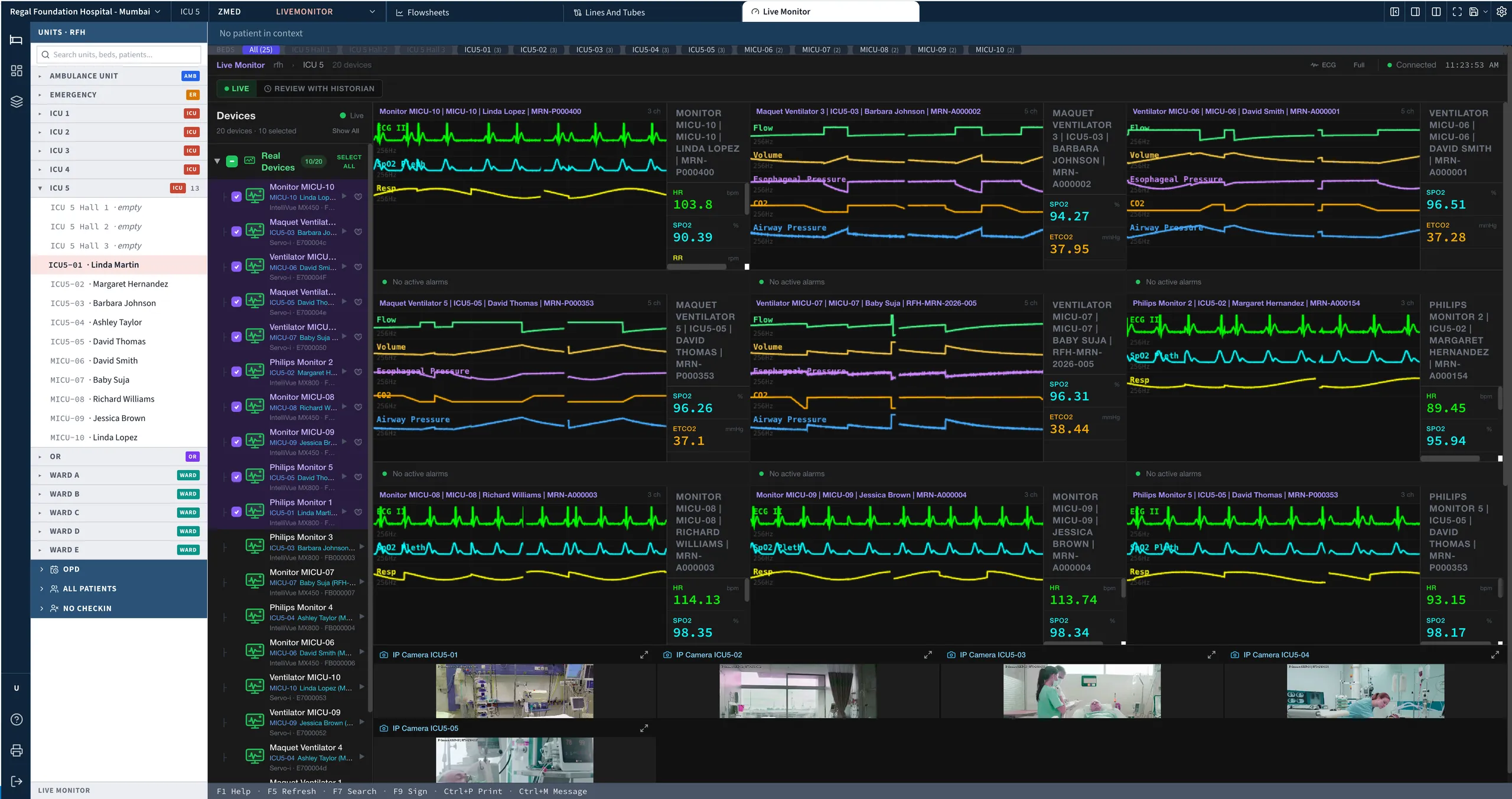
Works with the medical devices you already own. Monitors, ventilators, syringe pumps, anesthesia machines — plug-and-play, no rip-and-replace.

Lab & Radiology

Lab results, imaging orders, and a built-in radiology viewer — in the chart, where the clinician is already working.

EMR

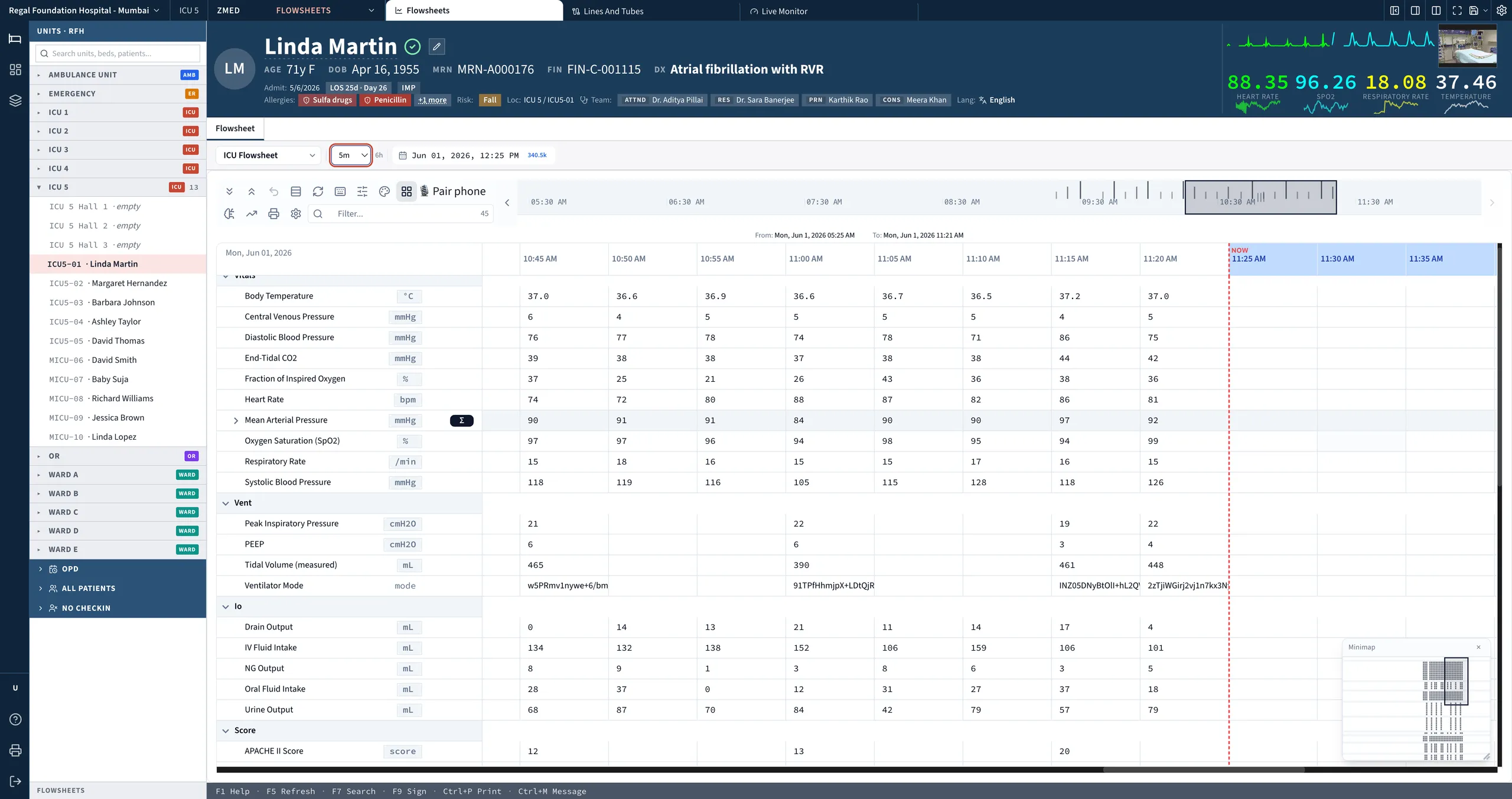
Flowsheets, clinical forms, order entry, and fluid balance — all designed around critical-care workflow, not generic ambulatory charting.

Enterprise Security & Compliance

HIPAA-aligned, audited to internationally-recognised information-security and medical-device quality standards. Role-based access, full audit trail, and encryption end-to-end.

Clinical QA

Configurable forms for audits, safety rounds, infection-control checks, and accreditation. The QA team builds their own — no developer, no ticket.

Clinical Scores

SOFA, APACHE, NEWS2, MEWS, Glasgow Coma — calculated live from the data already in the chart. No separate entry, no stale numbers.

Preview

Alert Management

Smart, prioritised, tunable. Alerts that reach the right clinician through the right channel — not a pager that buzzes for every blip.

Reports & Analytics

Unit dashboards, outcome metrics, and custom reports — built by administrators, not developers.

Service Models

Three ways to deploy

Match the deployment to the hospital. Small units go live in weeks on Cloud; large systems embed zMed into an existing IT estate with Enterprise; intensivist groups run multi-site tele-critical-care with Command Center.

zMed Cloud

5 – 100 beds

Pay per patient-day

  • SaaS deployment — no on-premise hardware beyond the bedside cable
  • Pay-as-you-use — bill tracks patient days, not seats
  • Single connectivity box per unit, self-install
  • Mobile app for clinicians, on-call physicians, and administrators
  • Typical go-live in weeks, not months
Talk to sales

Enterprise

100+ beds, multi-unit, multi-location

Licensed per bed

  • On-premise or managed cloud — your choice
  • Integration with your existing EMR, HIS, LIS, RIS, and PACS
  • Multi-site, multi-unit, multi-specialty deployments
  • Dedicated implementation team and 24×7 support
  • Data residency controls for regulated geographies
Talk to sales

Tele-ICU & Command Center

Physician groups, multi-hospital networks

Revenue-share with partner physician group

  • Built for intensivist groups running tele-ICU services
  • One command-centre view across every connected hospital
  • Audio and video with the bedside team, logged and audited
  • Co-branded deployments with partner physician groups
  • Outcome reporting for payers and contracting hospitals
Talk to sales

FAQ

Questions hospitals ask

Why zMed?

One comprehensive platform for the whole hospital — ICU to OR to ER to the back office — on one record and one audit log. It's built around the devices you already own and the way clinicians actually work, the AI is explainable and owned by your hospital, it runs in the cloud or fully on-premise, and it goes live fast. zMed has touched the lives of 300,000+ critical-care patients.

Which units does zMed cover?

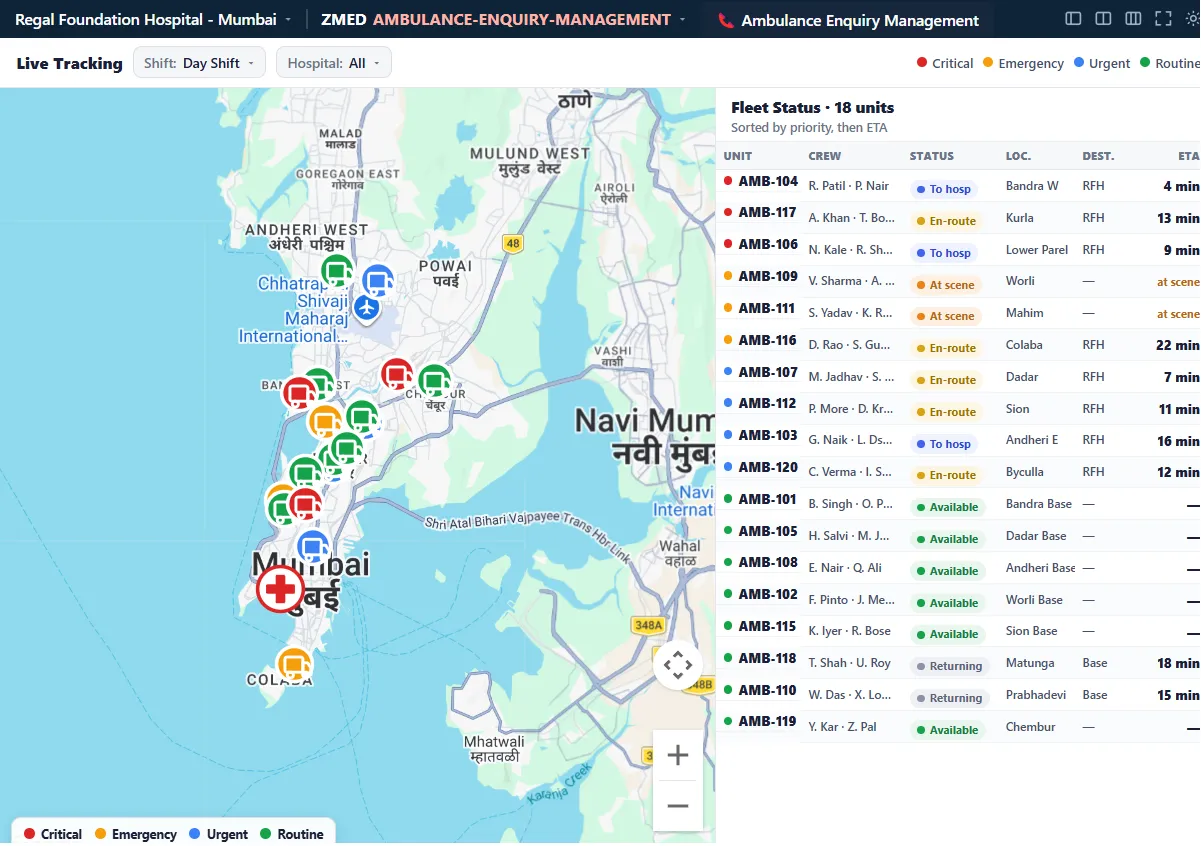
ICU and critical care, the operating room and anaesthesia, emergency/ER, ambulance and pre-hospital, tele-ICU and command centre, the hospital information system and ERP, clinical decision support, and the Claw AI layer — all on one platform, one record, one audit log.

What are zMed's levels of offering?

zMed is comprehensive, and you choose how far to take it — three levels you can start at and grow through. Clarity automates charting and gives the whole unit live visibility. Insight adds continuous clinical scores, smart alerts, and analytics. Foresight adds predictive AI — deterioration and sepsis foresight, and demand and occupancy forecasting. Start at any level and move up when you're ready.

How does zMed adapt to our existing workflows in the ICU, OR, ER, and other units?

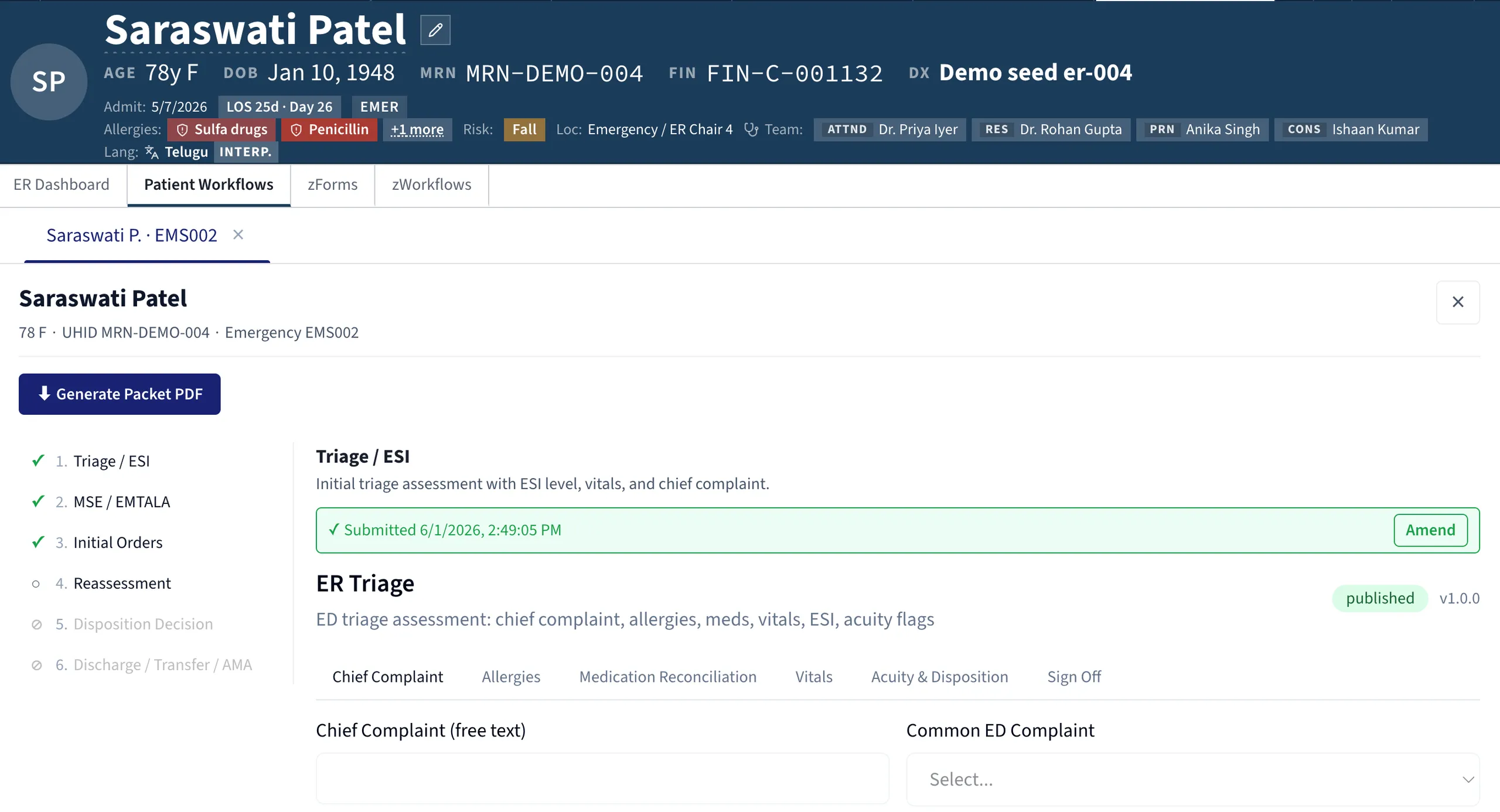
zMed is configured to your unit, not the other way round. Charting and protocols are built on zForms — configurable forms your hospital owns and changes the day a protocol changes, with no engineering involvement. Multiple zForms combine into a complete workflow for each unit (ICU, OR, ER, ward, and more), so the screen matches how your team already works. Templates, pathways, and rules are hospital-owned and adjustable per unit, role, and shift.

How is zMed deployed in a hospital?

Three ways: zMed Cloud for units of 5–100 beds (SaaS, pay per patient-day, live in weeks); Enterprise for 100+ beds (on-premise or managed cloud, integrated with your existing systems); and a Tele-ICU & Command Center model for physician groups and multi-hospital networks.

Can we trial zMed before committing?

Yes. You can start a self-serve trial at launch.zmed.tech, and we run on-site pilots for enterprise hospitals. Cloud units typically go live in weeks, not months.

What's the return on investment?

zMed gives clinicians their time back — teams chart by exception instead of re-keying, and smart alarm suppression cuts alarm load by 60–85%. It surfaces deterioration and sepsis 4–6 hours before they're clinically obvious, so teams intervene earlier. And it replaces two systems with one — clinical and administrative on a single record, with charge capture driven straight from the chart.

Does zMed integrate with our existing EMR, HIS, and medical devices?

Yes. zMed is device-agnostic and captures data directly from the monitors, ventilators, and anaesthesia machines you already own. It exchanges data with existing hospital systems over standard interfaces including HL7 and FHIR R4, so it fits the estate you have rather than replacing it.

How does zMed capture data from our bedside medical devices?

Through zMed's medical device data integration (MDDI) layer, which connects directly to patient monitors, ventilators, infusion pumps, dialysis machines, and anaesthesia machines and streams their data — including waveforms — into the chart in real time. It's manufacturer-agnostic, so it works with the mix of devices you already own. For older devices that have only a serial port and no network, zMed provides serial-to-WiFi IoT adapters that bring them onto the network, so even legacy equipment streams into the chart — nothing re-keyed, every value traceable to source.

Can zMed work with our existing lab (LIS/LIMS) and radiology systems?

Yes. zMed exchanges orders and results with your existing laboratory and radiology systems over standard interfaces (HL7 and FHIR; DICOM for imaging). A lab order placed in the chart reaches your LIS, and results return to the ordering clinician in the chart with abnormal values flagged. Radiology reports live in the chart with the image a tap away, opened in zMed's built-in DICOM viewer; for hospitals that need it, zMed includes an integrated imaging archive (PACS) powered by Orthanc, so studies are stored and viewed right alongside the record. Adopt zMed's HIS & ERP and lab worklists, results, and pharmacy are native too — but zMed runs just as well alongside the lab and PACS you already have.

What does zMed's AI (Claw) actually do?

Claw is zMed's AI layer, built into the chart rather than bolted on as a chatbot. It drafts notes and summaries from voice, surfaces deterioration and sepsis foresight inline, and offers decision support at the point of care. Every suggestion is explainable, advisory only, and human-in-the-loop — the clinician is always in control.

What AI features does zMed include?

The Claw layer spans prediction, automation, and assistance — built into the chart, advisory only, and human-in-the-loop (HITL): deterioration prediction (a continuous risk score and tier for every inpatient); sepsis foresight 4–6 hours pre-clinical; mortality and readmission risk; clinical-instability and smart-alarm pattern detection (alarm load down 60–85%); demand and occupancy forecasting; voice charting; self-drafting summaries (operative notes, shift handovers, discharge); and inline decision support. Every model is fitted on your hospital's own data, shows its contributing features, is one tap from override, and is audit-logged — the clinician's judgement is always the default.

What clinical decision support does zMed provide?

A comprehensive, hospital-owned CDS library — around 500 rules at go-live (about 50 literature-cited), surfaced inline at the point of decision and growing over time. Areas include: sepsis bundles and severe-sepsis escalation; drug–drug and drug–allergy interaction checks; renal dose adjustment; VTE prophylaxis; early-warning and deterioration escalation; care bundles and order-set pathways for sepsis, stroke, trauma, chest pain/STEMI, and medico-legal cases across ICU, OR, ED, and the ward; continuously recalculated clinical scores (SOFA, APACHE II, GCS, NEWS2, MEWS, qSOFA, RASS, CAM-ICU, and more); documentation prompts and medication sign-off checks; and predictive models for deterioration, sepsis trajectory, mortality, readmission, and instability. Every suggestion is explainable, advisory only, and human-in-the-loop, and your team owns the rules through a visual editor — every accept, override, and defer is logged.

What analytics, reports, and exports does zMed provide?

Built-in analytics and dashboards across clinical, operational, and financial views — census, throughput, length of stay, bundle compliance, turnaround times, and more — drawn live from the same record. Reports are template-driven and audit-linked, produced on demand or scheduled, and exportable to PDF for the board, payers, or regulators — every figure traceable back to the chart entry it came from.

Can zMed's AI run on-premise?

Yes. zMed runs in the cloud or fully on-premise, and the AI runs in a secure environment inside your own infrastructure — so patient data never has to leave the hospital, including in-country deployments for data-residency requirements.

How is patient data protected in the AI?

Privacy is the cornerstone of zMed's AI. Models run in a secure environment and are fitted on your hospital's own data, and your patient data is never used to train shared or third-party models. When a request is sent to a cloud AI model (such as Claude or OpenAI), protected health information is first redacted and de-identified by automated PII-detection tooling, so patient identifiers never leave your environment. Every prediction is advisory only and audit-logged, access is role-based, and deployments are HIPAA-aligned with data-residency options — including fully on-premise AI where nothing leaves the hospital at all.

Is the AI and clinical decision support regulator-ready?

The Claw AI layer and clinical decision support engine are explainable, advisory only, and human-in-the-loop (HITL) — the clinician is always in control, every suggestion shows its reasoning and can be overridden, and everything is audit-logged. The platform is designed to be FDA- and CDSCO-ready.

How does zMed handle data security and HIPAA?

zMed is built for regulated healthcare environments, with HIPAA-aligned controls, role-based access, full audit logging, and data-residency options for on-premise or in-country deployments. Every record and every AI suggestion is audit-logged.

Social Media

From the zMed feed

Follow zMed on LinkedIn for product updates, insights, and what we're building in critical-care automation.

Insights & Articles

Product & Photos

About zMed

zMed is a healthcare technology company designing and building software that addresses the real, multifaceted demands of modern clinical environments. Our work is researched, designed, and built in Chennai and Bengaluru, and deployed at major hospitals across India and beyond.

We work from a physician-centric point of view — every workflow is validated against what clinicians actually do at the bedside, in the operating room, and on the ward. Technology that respects clinician time is technology that gets used.

zMed office — IIT Madras Research Park, Chennai
IIT Madras Research Park · Chennai
zMed Bengaluru development center — NASSCOM CoE for IoT & AI, HSR Layout
NASSCOM CoE · HSR Layout, Bengaluru

Bengaluru

NASSCOM CoE – IoT & AI
HSR Layout, Bengaluru 560102

Chennai

IIT Madras Research Park
Taramani, Chennai 600113

USA

3900 Balcones Drive
Austin, TX

Launch your hospital

Start a trial or book a demo. We'll show you a live deployment, run through the workflows that matter to your unit, and answer every question your IT and compliance teams will ask.